European Expansion Audit for Sustainability SaaS: Why US ESG Platforms Struggle to Scale in the EU
European Expansion Audit for Sustainability SaaS: Why US ESG Platforms Struggle to Scale in the EU
For sustainability-focused SaaS companies, Europe is often considered the logical next step after US traction.
Comparable enterprise buyers. Advanced digital infrastructure. A shared urgency around climate and ESG performance.
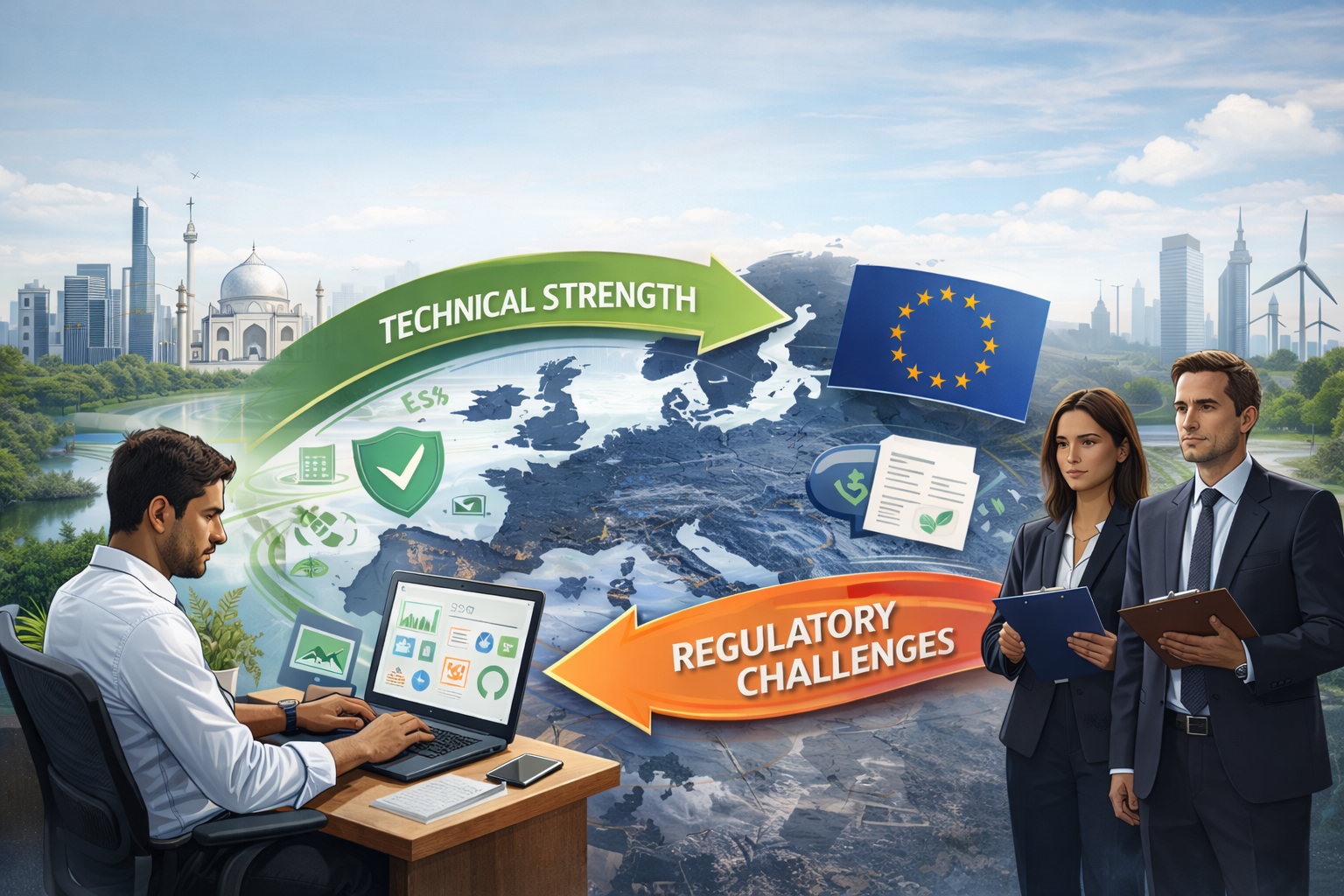
Yet expanding ESG software into the EU is not simply geographic growth. It is a structural transition into a regulatory-driven market where compliance architecture determines purchasing decisions. This is why many US sustainability SaaS Europe expansion initiatives underperform despite strong inbound demand.The issue is rarely market opportunity. It is structural readiness.
A Growing Market, Driven by Different Forces
The global ESG and sustainability software market continues to grow at sustained double-digit rates. North America leads in revenue. Europe follows closely. But the difference is not size, it is how demand is generated. In the United States, sustainability software adoption is largely market-led. Investor pressure, voluntary frameworks and corporate positioning influence buying decisions. For many organizations, sustainability SaaS is a strategic advantage. In Europe, sustainability is embedded in corporate governance. Through frameworks such as the Corporate Sustainability Reporting Directive (CSRD) and the Corporate Sustainability Due Diligence Directive (CSDDD), companies must produce standardized disclosures, demonstrate traceable due diligence and align with EU taxonomy requirements. Sustainability SaaS in Europe is evaluated as compliance infrastructure. Any EU market entry strategy that ignores this structural reality introduces hidden risk.
The Hidden Cost of Misalignment
The cost of structural misalignment rarely appears immediately on the P&L.
It shows up in twelve-month pilots that never convert. In localization budgets that double. In sales cycles that exhaust internal teams. In churn masked as “strategic reprioritization.” In Europe, structural misalignment does not fail fast, it drains slowly.
Many US ESG platforms enter the European market with strong early interest. Pipeline builds. Pilot programs launch. Momentum appears intact.
Yet conversion velocity remains below forecast. The friction is often attributed to pricing, procurement culture or localization gaps.
Frequently, it is architectural. When reporting logic does not fully align with CSRD requirements, when audit-level traceability is incomplete, or when regulatory monitoring processes lack clarity, European compliance teams pause decisions. What is often called regulatory technical debt is simply this: rebuilding data structures and reporting logic after contracts are already in motion because compliance expectations were underestimated. Correcting architecture after entry is significantly more expensive than conducting a structured EU market entry assessment or European Expansion Audit before scaling.
A Pattern Observed in Sustainability SaaS Europe Expansion
We have seen US ESG platforms enter Europe with strong inbound demand and credible enterprise conversations.
The product was strong, the structure was not fully aligned. During procurement, compliance teams required additional traceability layers, clearer hosting commitments and documentation of long-term regulatory monitoring processes. Negotiations extended. Product roadmaps shifted. Momentum slowed. After completing a formal European Expansion Audit and CSRD readiness assessment, the company restructured its reporting architecture and clarified its governance positioning. Subsequent negotiations closed in nearly half the projected timeline.
The difference was not innovation, it was alignment.
Before Scaling in the EU, Ask Yourself
If you are planning a sustainability SaaS Europe expansion within the next twelve to eighteen months, the most critical questions are architectural. Is your data model fully aligned with CSRD taxonomy requirements? Can your system withstand audit-level scrutiny across multiple EU jurisdictions? Do you have EU-based implementation or validation partners reinforcing credibility? Is your hosting architecture compatible with EU data sovereignty expectations? Can you demonstrate regulatory roadmapping beyond the next twelve months? If more than two of these answers are unclear, the risk may not be commercial execution. It may be structural readiness.
This is where a structured EU regulatory compliance assessment or Sustainability SaaS Europe consulting approach becomes strategic rather than optional.
The Upside of Getting Europe Right
Focusing only on risk understates the opportunity. The reward for structural alignment in Europe is disproportionate. Regulation-driven demand creates recurring revenue anchored in compliance obligations. Retention increases because the software becomes embedded in governance processes. Early ecosystem positioning strengthens defensibility. Market narratives become more credible to investors when regulatory exposure is clearly managed. In sustainability software, regulatory markets create structural durability. Europe is not just a complex geography.
It is a defensible growth engine, when approached correctly.
What a European Expansion Audit Delivers
A focused European Expansion Audit or EU market entry assessment provides clarity before capital and commercial acceleration increase exposure. It identifies regulatory alignment gaps at the data-model level. It reduces sales cycle uncertainty by validating compliance architecture before procurement escalation. It limits post-contract compliance rework by addressing structural weaknesses upstream.
It strengthens credibility with enterprise compliance and legal stakeholders early in the decision cycle. Organizations that integrate a formal Europe go-to-market audit before scaling frequently observe materially faster time-to-contract and fewer mid-cycle architectural revisions.
In regulatory markets, preparation compounds. Structural readiness is not an operational refinement. It is a strategic multiplier.
Europe as a Strategic Filter
Europe now functions as a structural filter for US sustainability SaaS companies. Those who replicate US go-to-market mechanics often encounter avoidable friction rooted in compliance misalignment. Those who begin with a formal EU expansion advisory process, validating regulatory, governance and ecosystem positioning before acceleration, build more durable and defensible positions.
The difference between prolonged validation and scalable EU growth rarely lies in innovation alone. It lies in alignment.
Why Fragmentation Is the Real Expansion Risk
What derails most sustainability SaaS expansions into Europe is not regulation alone. It is fragmentation. Product teams assess compliance readiness. Legal teams evaluate exposure. Sales teams pursue pipeline. Partner teams explore ecosystem opportunities.
But rarely does one function integrate market intelligence, regulatory alignment, go-to-market sequencing and ecosystem structuring into a single expansion architecture. European expansion in sustainability is not a sales challenge, nor purely a compliance exercise.
It sits at the intersection of product, regulation, ecosystem positioning and commercial timing. When that intersection is not owned, friction emerges. And friction compounds.
Europe Is Not a Market Entry. It Is an Expansion Architecture.
Europe is not simply another geography to activate. For sustainability SaaS and impact-driven companies, it represents a structural shift, one where regulation, ecosystem positioning, market intelligence and commercial sequencing must align from the outset. The companies that struggle rarely lack ambition. They struggle because expansion is treated as parallel initiatives rather than coordinated architecture.
When market intelligence, regulatory alignment and go-to-market strategy operate in silos, complexity increases. When they are orchestrated coherently, expansion accelerates. Structural clarity does more than reduce risk.
It transforms regulatory pressure into defensible positioning. It converts ecosystem alignment into trust. It turns ambition into measurable growth. In regulatory markets, architecture compounds.
You have questions?